


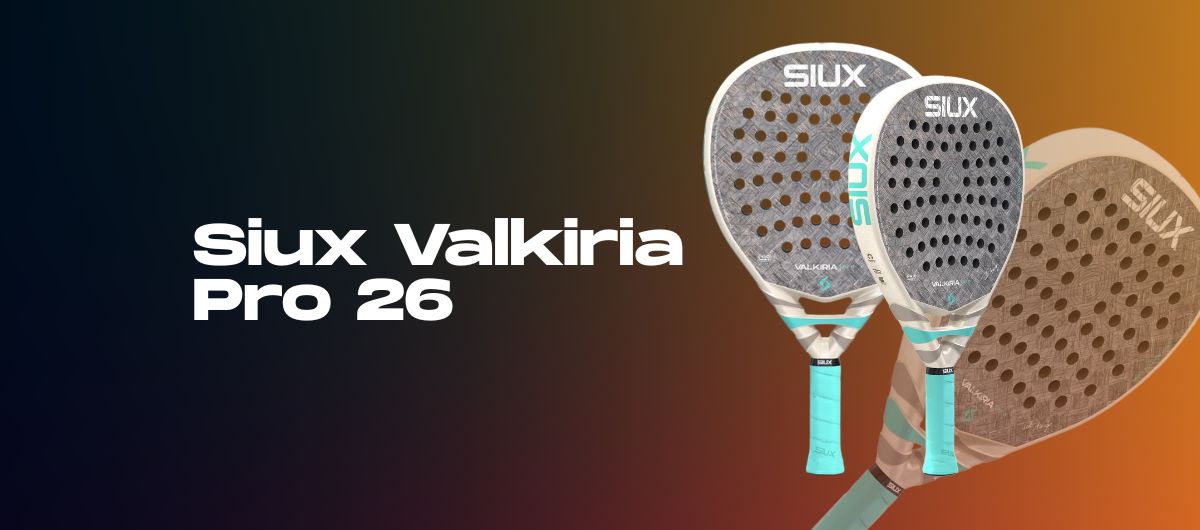
Siux Valkiria Pro 26 – Technical Review
The Valkiria Pro is Sofía Araújo's racket and is sold by just about every online shop as the light, manoeuvrable model in the Siux Pro line. That's true, just for a different reason than the product descriptions suggest. The short conclusion up front: this is the most forgiving racket in the line, and that's because the stiffness here comes from the face rather than from the core.

What the scales say
A tested example comes in at 355 grams out of the box, with a balance point of 26.5 centimetres. The factory spec runs from 340 to 360 grams, so this example sits at the top of the range, and yet it's the lightest of the three Siux Pros that were measured. The Electra Pro weighed 370 grams, the Fenix Pro 360.
The comparison with the Electra is the most interesting. It has exactly the same balance point of 26.5 centimetres, but weighs fifteen grams more. With that racket we already touched on the fact that you should always read balance point and weight together, and here's the textbook example: two rackets with an identical balance point, one of which feels noticeably heavier in the swing than the other. Of the three, the Valkiria has the lowest swing weight, and that's where its manoeuvrability comes from.
The twenty-gram spread within the same model name applies here too. When buying in a shop, ask for the weight, or weigh it yourself, because a 340-gram example is a different racket from this one.
The core: EVA Soft
This is where the technical difference from the other two lies, and it's worth pausing on for a moment.
In the Electra Pro and the Fenix Pro, the stiffness comes from the core: hard EVA under a stiff face. With the Valkiria it's the other way round. The core is soft and gives, while the stiffness comes from the surface. As a result, the ball stays on the face a little longer without the ball exit becoming slow. You get directional control from the face and ball feel from the core, instead of one coming at the expense of the other.
That's also where the price lies. If the stiffness comes from the surface, the power can't come from the core, because it barely springs back. And at 355 grams it doesn't come from mass either. Of the three, this racket has the lowest power ceiling, and that's not a shortcoming but the flip side of the same choice: you trade top-end speed for a racket that catches your mistakes.
The face: 24K Carbon Aluminized
Here too, the K number only tells you how many thousand filaments are in a bundle and nothing about the final stiffness. With this face, the difference lies in the word that follows. Aluminized means aluminium has been worked into the carbon layer, which makes the face stiffer and more direct without adding thickness.
What you feel is a face that barely flexes, with a somewhat metallic response on contact. That sounds harsh, and on its own it is, but here it sits on a soft core rather than a hard one. That combination is why this racket behaves differently from what the spec sheet would suggest.
Face shape and balance point
The Valkiria has a teardrop shape with a medium balance. The sweet spot sits slightly above the centre of the face, higher than on a round shape and considerably lower than on the Fenix Pro's geometric mould. More important than its position here is its size: the soft core enlarges the sweet spot, because on off-centre contact the foam absorbs some of the energy instead of letting it leak away. That's why this is the best defensive racket of the three, and the shape isn't the explanation.
At 355 grams and 26.5 centimetres, the manoeuvrability the online shops promise does hold true. It just doesn't come from the face shape, which is virtually the same as the Electra Pro's. It comes from the weight that isn't there.
Tuning with the dampeners
The Valkiria, too, no longer comes with ShockOut dampeners fitted in the face from the factory. They're available separately, and on a racket with a soft core they have a different effect than on the other two. Core and dampeners work at different levels: the core absorbs the impact, the dampeners take the residual vibration out of the face itself. So here you can increase the damping without losing ball feel.
If you hit hard, that's no unnecessary luxury. A soft core has limited room to deform, and on a full smash that room is used up before the ball leaves the face. From that point the foam absorbs nothing more and the shock goes straight through the carbon to your wrist and elbow. With this racket in particular, the dampeners are no cosmetic extra.
For set-up, the familiar principle applies: at 0.9 grams each, a single dampener barely changes your total weight, but its contribution to swing weight increases with the square of the distance to your wrist. Of the three, this is the only racket where going upwards is interesting. For the Fenix Pro the advice was to put everything at the bottom, because that mould is top-heavy enough already. Here there's room: at 355 grams with the lowest swing weight of the three, you can put dampeners in the top rows of holes and buy yourself some extra power without the racket immediately feeling sluggish. If you want it as a pure control racket, leave the top holes empty.
Interested in the 2026 Siux line-up? Browse our Siux rackets.


Leave a comment
This site is protected by hCaptcha and the hCaptcha Privacy Policy and Terms of Service apply.