


Siux Fenix Pro 26 – Technical Review
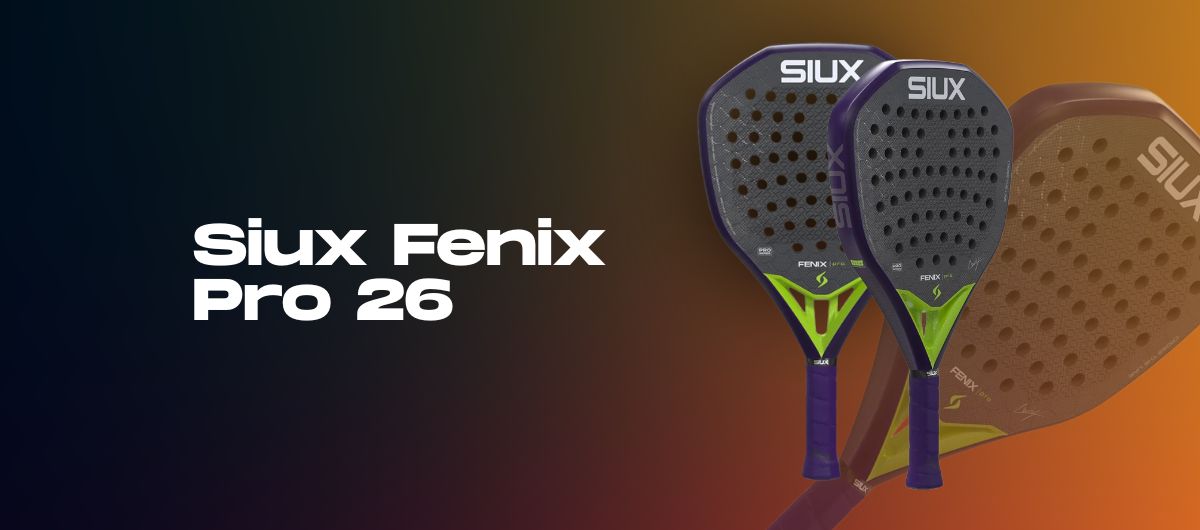
The Fenix Pro is Leo Augsburger's racket and the most outspoken attacking model Siux makes this season. You can see that before you even pick it up, because the shape gives it away straight away: this isn't a smooth diamond but a face with straight segments and visible corners. Siux itself calls it a geometric mould. The short conclusion up front: that angular shape explains why this racket hits so hard, and why it only does so when you strike the ball cleanly.

What the scales say
A tested example comes in at 360 grams out of the box, with a balance point of 27.5 centimetres. The factory spec is 355 to 375 grams, so this example sits right at the bottom of the range. Of the three Siux Pros that were measured, this is the lightest racket, and yet it feels the heaviest in the swing.
That's down to the balance point. That 27.5 centimetres isn't just high, it's the upper limit of what you'll find on the market. Siux hasn't added weight here but moved it: the scales show a normal number, while the swing weight is well above average. That's exactly what catches players out when they pick up rackets in a shop and weigh them by feel. Static weight says little about how a racket feels in the swing, and with this racket the two are further apart than anywhere else. The twenty-gram spread within the same model name applies here too, so ask for the weight or weigh it yourself.
The core: high-density EVA
The core is another step harder than the Electra Pro's. The same property, taken further: the foam barely deforms, the ball spends only a short time on the face and leaves quickly, provided you generate the speed yourself. The difference from the Electra is in what's left when you don't. There, the shape still absorbs a little; here, that doesn't happen.
That also makes it clear where this racket's power comes from. Not from a core that springs back, because it doesn't, but from the mould and the leverage that comes with it.
The face
The face is made of 12K carbon. As already described for the Electra Pro, that K number only tells you how many thousand filaments are in a bundle, and nothing about how stiff the laminate ends up. More relevant here is the finish: matte, with a pronounced 3D texture that grips the ball well. You notice that straight away on a vibora and a bandeja, although, like the rest of this racket, it demands clean ball contact before you see anything back from it.
Face shape and balance point: the geometric mould
This is the technical heart of the racket. A classic diamond shape runs from the heart of the racket towards the head in one continuous curve: the higher you go, the narrower the face becomes and the more material disappears. The Fenix doesn't do that. It has straight segments and corners exactly where a regular diamond would round off, so material stays where it would be gone with a rounded mould.
That material sits in two places at once, and each does something different. Mass high in the face lifts the balance point. That's where the 27.5 centimetres comes from. The lever is longer, so at the same swing speed more energy ends up in the ball. This racket hits harder than the Electra Pro while being ten grams lighter, and that's the explanation.
Mass far from the long axis increases torsional resistance, and that's almost never discussed. If you hit the ball away from the centre of the face, the racket wants to rotate around its own long axis. The further the mass sits from that axis, the more resistance there is. An angular head keeps material in its outer corners, so further from that axis than a rounded head does. Sideways mistiming therefore costs you less with this racket than you'd expect.
Tuning with the dampeners
The Fenix Pro, too, no longer comes with ShockOut dampeners fitted in the face from the factory. They're available separately, and with this racket, more than with the other two, they're worth it, because a core that deforms so little also absorbs little vibration. Whatever doesn't stay in the core ends up in your arm.
The same principle applies to set-up as with the Electra Pro: at 0.9 grams each, a single dampener barely changes your total weight, but its contribution to swing weight increases with the square of the distance to your wrist. With this mould, though, the direction is clear. Dampeners at the top amplify exactly what the Fenix is already extreme at, and for almost nobody is that a gain. The sensible move is downwards: everything in the bottom rows of holes. You keep the damping and win back a little reaction speed. It won't turn it into an all-rounder, but it does take the sharpest edge off.
Interested in the 2026 Siux line-up? Browse our Siux rackets.

Leave a comment
This site is protected by hCaptcha and the hCaptcha Privacy Policy and Terms of Service apply.