


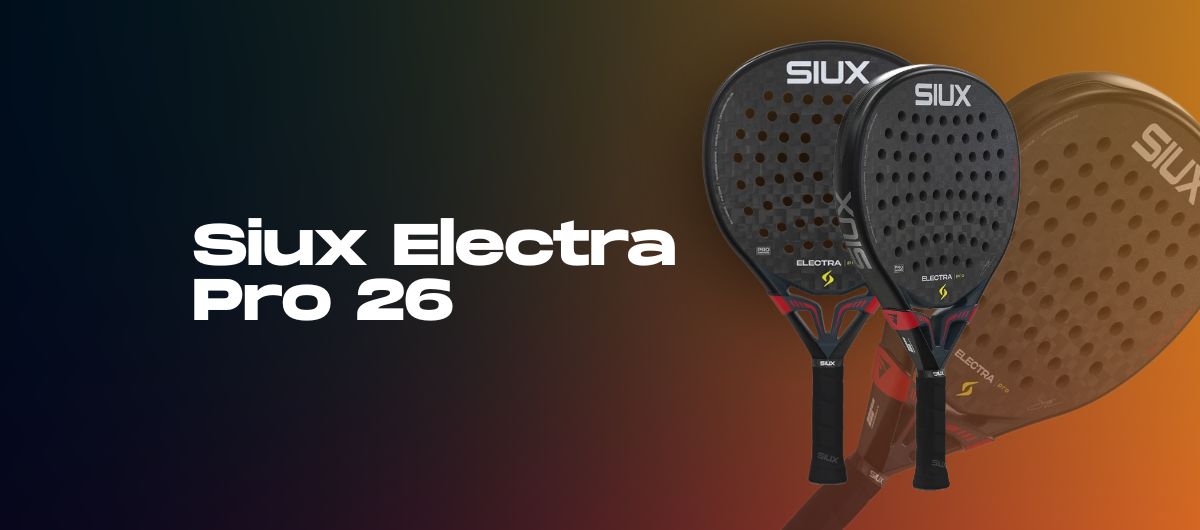
Siux Electra Pro 26 – Technical Review
The Electra Pro is Franco Stupaczuk's racket and occupies an interesting spot in the 2026 Siux line-up: harder than the all-round models and less extreme than the Fenix Pro. On paper, that's the classic middle ground where a lot of rackets come unstuck, because in the end they don't do either job well. That doesn't happen here, and the reason is the combination of a hard core with a shape that tames it again. The short conclusion up front: this is an attacking racket with a moderate teardrop shape that helps you keep the rally going.

What the scales say
A tested example comes in at 370 grams out of the box, with a balance point of 26.5 centimetres. The factory spec is 355 to 375 grams, so this example sits at the top of the range. Siux genuinely ships across that whole range, so the one you get in your hands could be twenty grams lighter than the one weighed here.
That makes comparisons with other rackets less reliable than they seem. With a twenty-gram spread within the same model name, the difference between two Electra Pros is bigger than the difference between an Electra Pro and its neighbouring model. If you read somewhere that this racket is surprisingly manoeuvrable for the power it delivers, that's probably true for that one example. When buying in a shop, ask for the weight, or weigh it yourself. And you can always fine-tune afterwards, because the ShockOut dampeners give you an easy way to adjust weight and balance.
The core: EVA Hard
The Electra Pro has a hard EVA core, and that core defines this racket's character more than its shape does. A hard core deforms less on impact, so the ball spends less time on the face. That produces a dry, direct response and a fast ball exit as soon as you generate the speed yourself. The downside comes from the same property: what deforms little also gives little back, so on a passive or rushed shot you get back exactly what you put in.
The face, and why the number of K's tells you less than the box suggests
The face is made of 12K carbon. That K number tells you how many thousand filaments are in a bundle, and nothing more. How stiff the laminate ends up depends on the weave direction, the number of layers, the resin ratio and the way the face is built onto the frame. A 3K face can therefore turn out stiffer than a 15K face, and within the same construction it can be just the other way round. The number doesn't predict the direction.
What you can establish is what you feel, and here that's a stiff face with little give that reinforces the hardness of the core rather than compensating for it.
Face shape and balance point
The Electra Pro has a teardrop shape that's slightly rounded at the head. That puts the sweet spot higher than on a round racket, but clearly lower than on a diamond. In practice you get a hitting zone that sits slightly above the centre of the face and extends reasonably far downwards. That explains why this racket holds up better in the rally than its core would suggest.
At 26.5 centimetres and 370 grams, though, you shouldn't treat this as a medium-balance racket any more. On paper 26.5 centimetres sits in the middle of the scale, but that scale assumes a racket of around 360 grams. Ten extra grams, spread over the same face, lifts the swing weight without the balance point moving a single millimetre. That's exactly why you should always read balance point and weight together.
Tuning with the dampeners
Siux no longer ships its rackets with ShockOut dampeners fitted in the face from the factory. A shame, because they're the rubber plugs you press into the holes in the face, and they're available separately. They serve two purposes at once. The first is damping: they take some of the vibration out of the face, and your arm will notice the difference. The second is set-up, and that's underused. At 0.9 grams each, a single dampener barely changes your total weight, but it isn't about the weight. It's about where that weight sits. Mass you place high in the face is further from your wrist, and its contribution to swing weight increases with the square of that distance. Half a gram at the top therefore counts for more in the swing than the same half gram just above the heart of the racket.
Interested in the 2026 Siux line-up? Browse our Siux rackets.


Leave a comment
This site is protected by hCaptcha and the hCaptcha Privacy Policy and Terms of Service apply.