


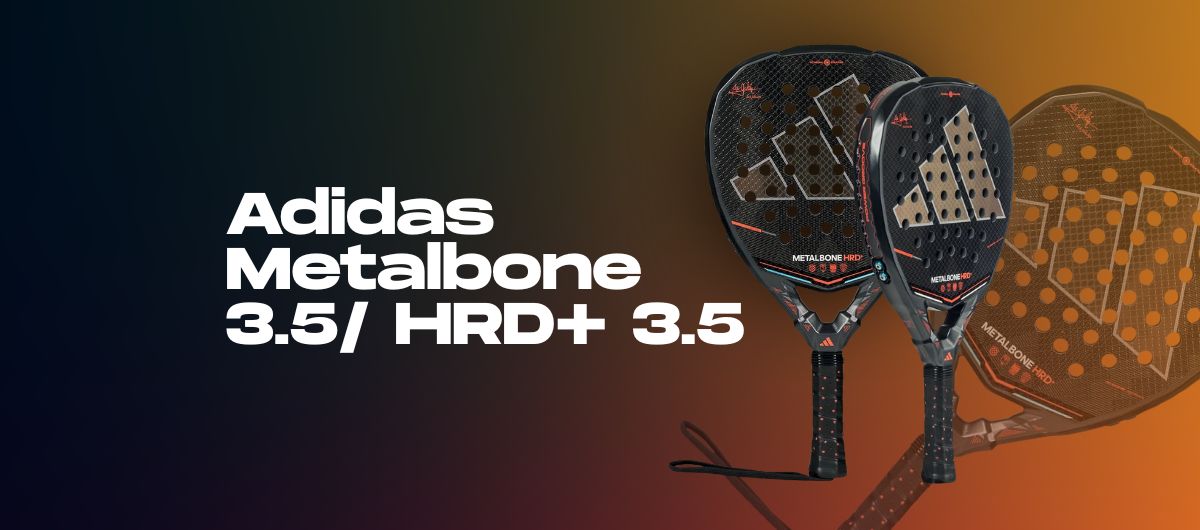
Adidas Metalbone 3.5 vs. Metalbone HRD+ 3.5 2026
The Metalbone has been the attacking weapon in the Adidas line-up for years, and for 2026 Ale Galán's signature racket comes in two flavours that you can't tell apart by looking at them: the standard Metalbone 3.5 and the Metalbone HRD+ 3.5. We cover them in one review for a simple reason: technically they're almost identical. Face, frame and shape are the same. The only real difference is in the core, hard EVA versus softer EVA.
Two things stand out straight away when measuring. In practice, both rackets weigh around 369 to 370 grams, roughly ten grams more than the stated 345 to 360 grams. That's not a manufacturing fault, but it is a reason not to take the factory spec as gospel and to put every racket on the scales yourself. On top of that, the balance point, a high 27 cm, is virtually identical between the two models, which points to tight quality control of the kind you more often see with the bigger brands.

The standard Adidas Metalbone 3.5 2026 is the version that works out best for players who mostly play in mild to cool conditions, thanks to a softer core that keeps its liveliness when temperatures drop. View the Adidas Metalbone 3.5 2026 on the product page.

The Adidas Metalbone HRD+ 3.5 2026 is the pick for anyone looking for a harder, more direct feel, or who plays a lot on hot courts. View the Adidas Metalbone HRD+ 3.5 2026 on the product page.
The Weight and Balance System
A separate word on the balance system, because it's one of the strongest innovations on the market right now. Using four screw-in weights in the heart of the racket, you set the balance yourself: weight towards the top for more power, weight out or lower down for more manoeuvrability. In practice, both rackets balance at around 27.1 to 27.4 cm out of the box, and with a few minutes of tinkering you can bring them to exactly the same balance. For almost every serious player, this system is more than enough to set the racket up completely to suit their own game.
The only real difference: the core
All the performance differences between these two rackets come down to one component: the EVA foam. The standard Metalbone uses a Soft Performance EVA with a medium-hard density. That gives a little more trampoline effect, more ball feel and a larger sweet spot.
The HRD+ uses a denser, harder foam that Adidas calls High Recovery Density, with more shape memory. That hard foam gives a more direct, drier response and more control at high impact speeds, but in return delivers a smaller sweet spot and less output at lower speeds.
Why temperature plays a part
This is where the choice between the two rackets becomes practical. EVA foam is temperature-sensitive, and that works both ways. Roughly speaking, the foam gets softer above 25 degrees and harder below 10 degrees. Soft foam can become unplayably soft in the heat, with too much trampoline effect, so you lose control. Hard foam, on the other hand, becomes rock-hard in winter: great for the enthusiast, but less pleasant for your arm.
The logic that follows is that the hard core of the HRD+ is the better choice mainly when you're playing in the heat. So the real question is how often you play in which conditions. If most of your padel is played in mild or cool temperatures, the softer foam of the standard version stays nicely lively, and you benefit from the extra ball feel and larger sweet spot. If you regularly play in the heat, the HRD+ is the more logical choice, because its harder foam holds its control just when a softer core would turn too soft.
What Galán's game teaches us
A nice detail that supports this reasoning comes from Ale Galán himself. He reportedly plays with a racket of around 380 grams without screw-in weights. That's heavier than the standard version, and the most likely explanation isn't extra lead but the foam itself: a denser, harder core simply weighs more at the same volume. On tour, Galán almost always plays in warm conditions, and that's where that hard, heavy foam fits perfectly. It delivers maximum control and power exactly when a softer core would become too soft.
Keep an eye on what happens when tournaments are played in colder countries. Then he seems to reach for a softer, lighter core, sometimes adding screw-in weights to reach his preferred total weight. That isn't firmly confirmed, but what he has said himself in various interviews is that he switches between the harder and the softer Metalbone depending on the conditions. That makes him living proof of the principle this review is built around: the right core depends on how and where you play.
The handle
One detail few players talk about is the handle. In the professional game, grips are often fully custom-made, but Adidas already supplies a comfortable handle from the factory. The slightly larger butt cap in particular gives a firm, familiar feel in the hand. That gives you grip on full swings and stops the racket from twisting in your hand.
Final verdict
The Adidas Metalbone 3.5 2026 stands out thanks to the sum of an adjustable balance system, a choice of two core hardnesses for different conditions, and a level of finish you don't see everywhere in this segment. The result is an extremely stable attacking racket that gives you more control and confidence at the net and in defence than you'd expect from a head-heavy diamond racket.
The difference with the HRD+ is purely a matter of core: choose the standard version for moderate temperatures and a little more ball feel, and the HRD+ for hot courts and a harder, more direct feel. If you bring clean technique and want to finish points at the net, both versions give you one of the most complete and adjustable power rackets in this segment. Not sure which version suits you? Get in touch with our team and we'll help you choose, or browse all Adidas rackets.

Leave a comment
This site is protected by hCaptcha and the hCaptcha Privacy Policy and Terms of Service apply.