


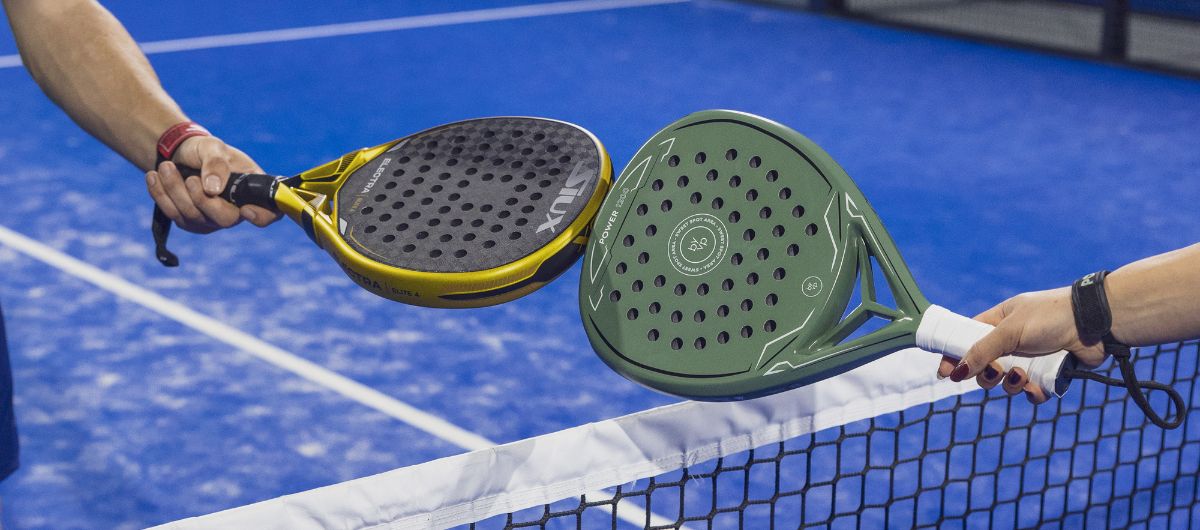
In short: Padel is scored like tennis (15, 30, 40, game; six games to a set; best of three sets). You serve underarm after bouncing the ball, hitting it at or below waist height, diagonally into your opponents' service box. The ball must bounce on the ground in your opponents' half before it touches their walls or fence. After that bounce, it can come off any wall and stays in play until it bounces a second time. At 40–40, the current International Padel Federation (FIP) rules allow three formats: advantage, golden point and the newer star point.
This guide follows the official FIP Rules of Padel (the version applying from 1 January 2026). Rule numbers in brackets refer to that document, so you can check the details yourself. Social games at Australian clubs follow the same basics.
The court in one minute
A padel court is a fully enclosed rectangle, 10 metres wide and 20 metres long (inside measurements), split in half by a net that is 0.88 m high in the centre and 0.92 m at the ends. The service lines run parallel to the net, 6.95 m from it on each side, and a centre line divides each service area into two boxes. The ends are enclosed by 3 m of wall topped by a metre of metal mesh, and the sides combine glass or wall panels with mesh fencing.
Scoring in padel
Points, games and sets
Points go 15, 30, 40 and game, as in tennis (Rule 1). The first pair to win six games with a two-game margin wins the set. At 5–5 you play on to 7–5, and at 6–6 there's a tie-break. A standard match is the best of three sets. If it has been agreed beforehand, the third set can be played without a tie-break, so a pair has to get two games clear.
The tie-break
The tie-break is won by the first pair to reach 7 points with a two-point margin, and that wins the set 7–6. The player due to serve takes the first point from the right side. After that, each player serves two points in turn, and the pairs change ends after every six points.
What happens at 40–40: advantage, golden point or star point
The FIP rules give three options for deuce:
- Advantage. The traditional format: at 40–40 ("deuce"), you need to win two points in a row to take the game.
- Golden point. At 40–40, one deciding point is played and the winner takes the game. The receiving pair chooses whether to receive on the right or the left, but the players can't swap positions to do it. In mixed matches, the receiver must be the same sex as the server.
- Star point. This is the newer option, and it's a middle ground. At the first deuce you play for advantage as normal. If the game returns to deuce a second time, you play for advantage again. If it reaches a third deuce, a single deciding point (the "star point") settles the game, with the same receiving rules as the golden point.
The FIP uses the star point on its FIP Promises junior tours from 2026, but you'll find all three formats at club level, so ask before the first point.
Shorter formats
The rules also describe quicker formats that clubs and social competitions often use (Rule 1, alternative scoring): a mini set to four games (tie-break at 4–4), or a tie-break (to 7) or super tie-break (to 10, win by two) in place of a third set.
The serve
Every point starts with a serve, and you get two attempts (Rule 6). To serve correctly:
- Stand behind the service line, between the centre line and the side wall, and stay there until you've hit the ball. Your feet must not touch the service line or the imaginary extension of the centre line.
- Bounce the ball on the ground in that area before you hit it.
- Hit the ball at or below waist height, with at least one foot on the ground.
- Serve diagonally over the net so the ball bounces in your opponent's service box. The lines count as in.
You start each game serving from the right side, then alternate sides after every point. The serving order is decided at the start of each set and stays the same throughout it.
Service faults
Your serve is a fault if (Rule 7):
- you break any of the serving rules above;
- you swing and miss;
- the ball lands outside the correct service box;
- the ball hits you or your partner;
- the ball bounces in the box and then hits the metal fence before its second bounce. Hitting the glass after the bounce is fine, but the mesh is a fault;
- the ball bounces in the box and goes straight out through a court door where out-of-court play isn't allowed.
Two faults in a row lose you the point.
Returning the serve
The receiver must let the serve bounce in the box before returning it (Rule 8). If the serve hits the receiver or their racket before it bounces, the point goes to the server.
Lets and net serves
A serve is a "net" and is taken again if it clips the net or posts and then lands in the correct box, as long as it doesn't hit the mesh fence before the second bounce (Rule 9). A serve is also replayed if the receiver wasn't ready. A let on the first serve means the point restarts with two serves. A let on the second serve means you replay only the second serve.
During a rally, a point is replayed (a "let point") if the ball breaks, something from outside invades the court, or there's an unexpected interruption that has nothing to do with the players (Rule 10). Accidentally putting off an opponent while they're hitting is treated as interference. The first time it's a let, but deliberate interference, or a second accidental one by the same pair, costs you the point (Rule 11).
Walls, glass and the fence
This is the part that makes padel unique, and it comes down to a few principles (Rules 12–14):
- Bounce first. Your shot must bounce on the ground in your opponents' half before it touches their walls or fence. If it hits their glass, their fence or anything else first, you lose the point.
- After the bounce, the walls are live. Once the ball has bounced in a player's half, it can hit the glass or the fence and stays in play until it bounces a second time. You can wait for it to come back off the glass and then hit it.
- Your own walls can help you. You're allowed to hit the ball into the walls on your own side so that it rebounds over the net, as long as it then bounces in your opponents' court.
- But not your own fence. If you hit the ball and it touches the metal mesh on your own side, or the ground on your side, you lose the point (Rule 13).
- Corners count. A ball that lands in the corner where the wall meets the ground is a good return.
Want to use the glass well? Read our guide on how to use the glass wall in padel.
When the ball leaves the court
If your shot bounces in your opponents' court and then flies out over the wall or through a door, what happens depends on the court. Where out-of-court play is authorised (the court has the required safety area), your opponents can run outside and play it back (Rules 13 and 16). Where it isn't, they lose the point. You also win the point if, after bouncing, the ball goes through a hole in the fence, gets stuck in it, or lodges on the flat top of a wall (Rule 15).
Other ways to lose a point
Beyond double bounces and wall-first shots, you lose the point if (Rule 13):
- you, your racket or your clothing touch the net, the posts or your opponents' side while the ball is in play;
- you hit the ball before it has crossed the net;
- you hit the ball twice, or both you and your partner hit it;
- the ball touches you or your partner (anywhere except the racket);
- you throw your racket at the ball, or jump over the net during a point;
- you drop your racket or your safety cord breaks.
Changing ends and time between points
Pairs change ends after the first, third and every following odd game of a set (Rule 5). In official matches you get up to 20 seconds between points, 90 seconds when you change ends and 120 seconds between sets. After the first game of each set, you change ends without a break (Rule 2).
Etiquette on Australian courts
- Agree on the scoring format (advantage, golden point or star point) and whether out-of-court play is allowed before you start.
- Call the score before you serve.
- Make your own line and wall calls honestly. If in doubt, replay the point.
New to the sport? Start with how to start playing padel in Australia, which also links to our city guides for finding a court. Padel Australia explains the basics too, on its how to play padel page.
Gear up before you play
- Beginner padel rackets: forgiving models for new players.
- All padel rackets: our full range.
- Padel balls: stock up so every booking starts with fresh balls.
- Racket Finder
- Racket Reviews by Sven Boele
Orders placed before 4 pm Sydney time ship the same day, and standard shipping (2–5 business days) is free from $200.
Padel rules FAQ
Can the ball hit the fence in padel?
Yes, but only after it has bounced on the ground in your opponents' half. If your shot hits their fence or glass before bouncing, you lose the point. A serve that bounces in the box and then hits the mesh fence is a fault, and hitting the ball into the mesh on your own side loses you the point.
Can you hit the wall first in padel?
You can play the ball into the walls on your own side so that it rebounds over the net, as long as it then bounces in your opponents' court. You can't hit your opponents' walls directly.
What is the golden point and the star point in padel?
Both are ways to finish a game at 40–40. With the golden point, a single deciding point is played at the first deuce. With the star point, you play two rounds of advantage first, and a deciding point is played only if the score reaches deuce a third time. In both cases, the receiving pair chooses which side receives.
Do you get two serves in padel?
Yes. If your first serve is a fault you get a second one, and two faults in a row lose the point. A serve that clips the net and lands in the correct box is replayed.
Can you play padel singles?
The FIP rules are written for pairs, and padel is almost always played as doubles. Some Australian clubs do have dedicated singles courts, though. In Sydney, Sidewall Social has two, and in Melbourne, Nordic Padel has one.

Leave a comment
This site is protected by hCaptcha and the hCaptcha Privacy Policy and Terms of Service apply.